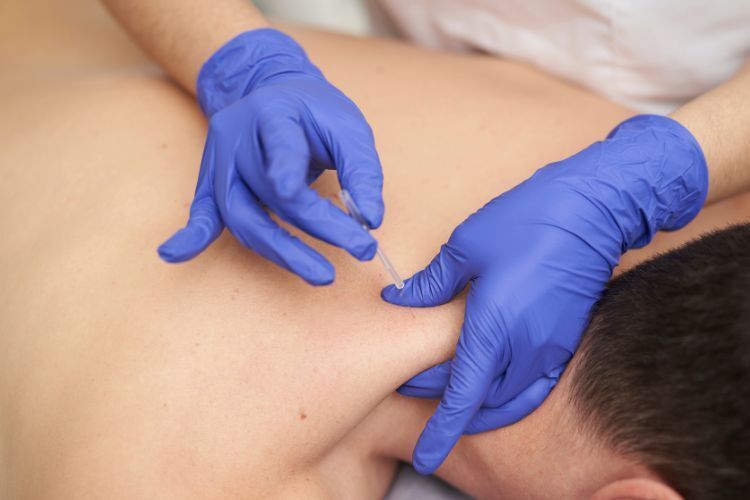
If you've ever pushed through a tight hamstring, a stubborn shoulder, or nagging knee pain to keep training, you already know that muscle tightness rarely resolves on its own. Dry needling for sports injuries has become one of the most effective tools athletes and active patients use to break through that plateau. At Towson Integrative Health, dry needling is one of the modalities Dr. Paul Abosh uses alongside chiropractic care and physical therapy to help patients in the Towson and Baltimore metro area get back to the activities they love, faster and with less pain.
This post breaks down what dry needling actually is, how it works, and why it's become such a valuable option for treating sports injuries.
What Is Dry Needling?
So what is dry needling, exactly? It's a treatment technique where a trained provider inserts a thin, sterile needle into a specific muscle trigger point, the small, tight knot that forms in overworked or injured muscle tissue. Unlike acupuncture, which is rooted in traditional Chinese medicine and focuses on energy pathways, dry needling is grounded in modern anatomy and neuroscience. The goal is simple: release the trigger point, reduce muscle tension, and restore normal movement patterns.
For athletes, this matters because trigger points often form after repetitive strain, overtraining, or an acute injury like a pulled muscle or sprain. Left untreated, those knots can limit range of motion and set the stage for compensation injuries elsewhere in the body.
How Dry Needling Therapy Works
Dry needling therapy targets the neuromuscular system directly. When the needle enters a trigger point, it triggers a small local twitch response. That response helps interrupt the pain signal being sent to the brain and encourages the muscle fibers to release and relax.
Patients often notice one of two things right away: a brief, distinctive ache during the twitch response, followed by a sense of looseness in the treated area. Many describe it as feeling like a deep, productive stretch. The effects build over the following 24 to 48 hours as blood flow increases and the muscle continues to release.
This is different from simply stretching or foam rolling, which work on the surface level. Dry needling reaches deeper into the muscle tissue, which is part of why it's so effective for chronic tightness that hasn't responded to other approaches.
The Benefits of Dry Needling for Athletes
The benefits of dry needling extend well beyond pain relief. For active patients dealing with sports injuries, the treatment can:
- Reduce muscle tightness and spasm around an injured area
- Improve range of motion needed for sport-specific movement
- Decrease pain associated with overuse injuries like tendinitis or IT band syndrome
- Speed up recovery time between training sessions
- Address compensation patterns before they turn into secondary injuries
One of the most common scenarios we see involves runners or weekend athletes who developed calf tightness or hip flexor pain after ramping up training too quickly. Rather than sitting out for weeks, many find that a few sessions of dry needling paired with targeted rehab exercises gets them back to full activity in a fraction of the time.
Why Dry Needling Works Best as Part of a Bigger Plan
Here's something patients don't always expect: dry needling on its own often isn't enough to fully resolve a sports injury. If the underlying joint mechanics are off, a tight muscle will simply tighten right back up after treatment. This is why dry needling physical therapy works best when it's combined with hands on chiropractic care.
At Towson Integrative Health, this is the whole point of the integrated model. Dr. Abosh combines chiropractic adjustments with physical therapy, including dry needling, kinesiotaping, joint mobilization, and rehab exercises, at every single visit. If a joint is compressing a nerve or restricting movement, no amount of needling or stretching will fully correct the problem until that joint restriction is addressed. Patients get more complete, longer-lasting results because both the muscle tissue and the joint mechanics are treated together, rather than one being left out.
Common Sports Injuries That Respond Well to Dry Needling
Dry needling for myofascial trigger points is particularly effective for:
- Hamstring and calf strains
- Shoulder impingement and rotator cuff tightness
- Lower back tightness from repetitive loading
- Knee pain related to IT band or quad tightness
- Neck and upper trap tension from posture or contact sports
- Plantar fasciitis and lower leg tightness in runners
If you've been dealing with any of these issues and traditional rest or stretching hasn't fully resolved them, it may be time for a more targeted approach.
What to Expect at Your First Visit
During an initial visit, Dr. Abosh evaluates the injury, identifies which muscles are holding tension, and determines whether dry needling is appropriate alongside chiropractic and physical therapy. Most patients tolerate the treatment well, and any soreness afterward typically resolves within a day or two, similar to the feeling after a hard workout.
Because every patient's injury and activity level is different, treatment plans are built around individual goals, whether that's returning to competitive sport, getting back to weekend recreational activity, or simply moving through the day without pain.
Ready to Get Back to Full Activity?
Sports injuries don't have to sideline you for weeks. Dry needling for sports injuries, combined with chiropractic care and physical therapy, addresses both the muscle tightness and the underlying mechanical issue causing it. That combination is what makes recovery faster and results more durable.
If you're an athlete or active patient in the Towson or Baltimore metro area dealing with a nagging injury, Towson Integrative Health can help you build a recovery plan that gets to the root cause. Schedule a visit with Dr. Paul Abosh today and take the first step toward getting back in motion.
.jpg)
.jpg)