Wellness · September 2, 2026
Most people assume that joint pain, stiffness, and nagging discomfort are simply the result of aging or a specific injury. But the truth is, some of the most significant damage to your spine and joints happens gradually — one small, repetitive movement at a time. Here in Towson, MD, patients come into Towson Integrative Health every week surprised to learn that the way they sit at their desk, load the dishwasher, or even carry their bag is quietly adding stress to their body day after day. The good news? Once you understand what's happening, you can make small changes that protect your joints and help you move better for decades to come.
What is cumulative wear and tear?
Cumulative wear and tear — sometimes called repetitive stress or microtrauma — refers to the gradual breakdown of joints, cartilage, discs, and soft tissue that happens when the body is repeatedly exposed to suboptimal loading, poor mechanics, or sustained awkward postures. Unlike a sudden injury, this type of damage builds silently over months and years before it becomes painful enough to notice.
Why Everyday Movements Matter More Than You Think
There is a common misconception that you have to do something dramatic — lift something too heavy, twist the wrong way, or get into a car accident — to damage your spine or joints. In reality, research consistently shows that repetitive, low-load movements performed with poor mechanics are responsible for a significant portion of chronic musculoskeletal conditions. The human body is extraordinarily resilient, but it was designed to move in specific, efficient patterns. When those patterns are disrupted, even mild stress accumulates over time.
Think about it this way: bending your neck forward to look at your phone for 30 minutes adds far more compressive force to your cervical spine than you might expect. Studies in biomechanics suggest that tilting your head just 30 degrees forward can multiply the effective weight your neck must support several times over. Now multiply that loading pattern across dozens of sessions per day, seven days a week, year after year. That is how everyday habits become the root cause of neck pain, disc degeneration, and chronic headaches.
At Towson Integrative Health, Dr. Paul M. Abosh, DC, CCSP, CCEP, CKTP often tells patients that the body keeps a very accurate scoreboard. Every poor posture, every awkward repetitive motion, every hour spent in a suboptimal position is recorded in your joints and connective tissue. The goal isn't to live in fear of movement — quite the opposite. It is to understand your movement patterns well enough to protect yourself and continue doing the activities you love for as long as possible.
Common Everyday Movements That Are Secretly Causing Wear and Tear
You might be surprised at how ordinary these habits look from the outside. That is exactly what makes them so easy to overlook.
Sitting with a forward head posture. Whether you are working at a computer, watching television, or scrolling your phone, allowing your head to drift forward of your shoulders creates sustained compression in the cervical and upper thoracic spine. Over time, this alters the natural curvature of the neck, loads the facet joints unevenly, and can accelerate disc breakdown between the vertebrae.
Slouching while seated. Prolonged slouching flattens the lumbar curve and shifts compressive forces to the back portion of the lumbar discs — exactly where disc herniations tend to originate. Many patients who come into our Towson clinic with low back pain are shocked to realize that sitting is often more stressful to the spine than standing or walking.
Repetitive one-sided loading. Carrying a heavy bag on the same shoulder every day, crossing the same leg habitually, or always sleeping on one side with no pillow support creates muscular imbalances and uneven joint loading. Over time, this causes one side of your body to compensate for the other, wearing down certain structures faster than they should.
Improper lifting mechanics. This doesn't just apply to the gym. Loading the dishwasher, picking up laundry, retrieving something from the bottom of a bag — every one of these moments involves a spinal load. Rounding the lower back while bending forward dramatically increases the compressive and shear forces on the lumbar discs. Most people do this dozens of times every single day without realizing it.
Extended static postures without movement breaks. Sitting or standing in one position for long stretches without shifting weight or moving reduces circulation to the intervertebral discs, which rely on movement-driven fluid exchange to stay hydrated and healthy. Stagnant postures also cause muscle fatigue and joint stiffness, which forces the body into compensatory patterns over time.
Looking down at a phone or tablet. This has become so common in our daily lives that it has earned its own name in clinical circles: "tech neck." The repetitive forward flexion of the cervical spine associated with device use is one of the most rapidly growing contributors to neck pain, upper back tension, and cervicogenic headaches that Dr. Paul M. Abosh, DC, CCSP, CCEP, CKTP sees at Towson Integrative Health.
How Posture and Body Mechanics Factor In
Posture is far more than how you look standing in front of a mirror. It is the real-time expression of your neuromuscular system — a reflection of which muscles are active, which are inhibited, how your joints are aligned, and how efficiently your nervous system is coordinating everything together. Poor posture does not simply mean you look slouched. It means your spine is absorbing loads in patterns it was not designed to sustain repeatedly.
Body mechanics refers to the way you move through daily tasks — how you bend, lift, twist, push, and carry. Poor body mechanics multiply the forces placed on your joints in ways that healthy mechanics do not. A well-timed hip hinge and a rounded lumbar bend may look very similar from a distance, but biomechanically, they produce entirely different outcomes for your spinal structures.
Here in the greater Baltimore area, we see patients from Towson, Timonium, Parkville, and surrounding communities who have developed chronic conditions — disc problems, facet joint irritation, tendinopathies, and hip degeneration — that trace back directly to long-standing postural habits and mechanical patterns. The encouraging reality is that identifying and correcting these patterns early can significantly slow or even reverse some of the structural consequences that come from years of cumulative stress.
This is exactly why Towson Integrative Health takes a root-cause approach rather than simply treating symptoms as they surface. Understanding the mechanics behind your daily life is how we build a care plan that produces lasting results.
How Chiropractic and Physical Therapy Care Can Help
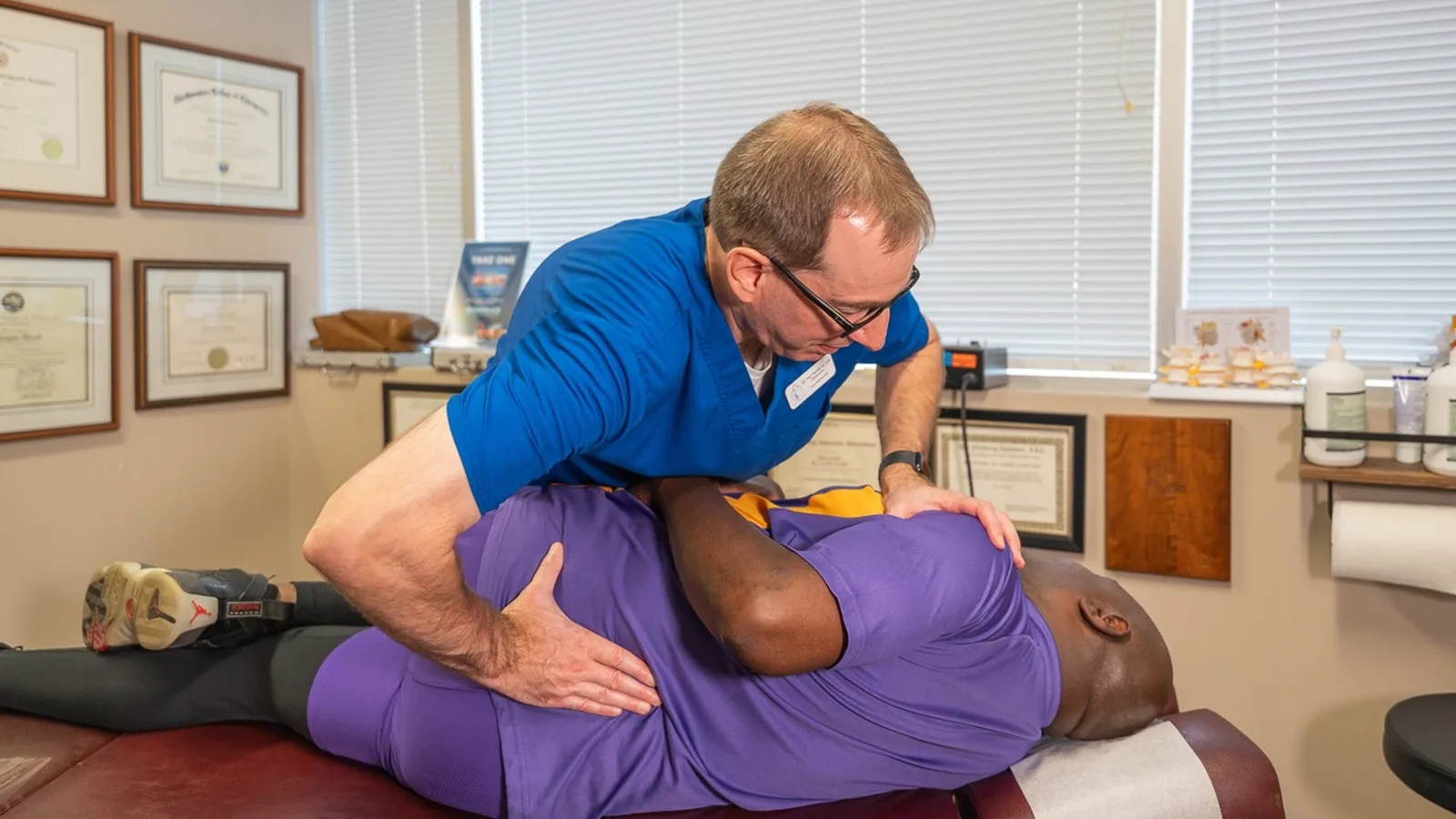
Chiropractic care addresses the structural and neurological consequences of cumulative wear and tear in a non-surgical, drug-free way. When joints become restricted or misaligned from repetitive stress, they lose their normal range of motion and may begin to affect surrounding nerves, muscles, and connective tissue. Chiropractic adjustments are designed to restore proper joint motion, reduce localized inflammation, and support the nervous system's ability to communicate clearly with the rest of the body.
At Towson Integrative Health, Dr. Paul M. Abosh, DC, CCSP, CCEP, CKTP goes beyond traditional chiropractic adjustments alone. As a practice that integrates chiropractic care, physical therapy, trigger point dry needling, and personalized lifestyle coaching under one roof, the team builds individualized care plans that target the actual source of each patient's problem — not just the location where pain happens to show up.
For patients dealing with wear and tear patterns, care might include spinal manipulation to restore joint motion, targeted rehabilitative exercises to correct muscular imbalances and strengthen stabilizing muscles, trigger point dry needling to release chronically overworked soft tissue, and movement education to rewire the daily habits contributing to the problem. This kind of coordinated, multi-disciplinary approach is what distinguishes Towson Integrative Health from practices that address one piece of the puzzle at a time.
Evidence from organizations like the American College of Physicians and the National Center for Complementary and Integrative Health supports chiropractic care as a recommended first-line conservative approach for conditions like low back pain, neck pain, and musculoskeletal disorders — the very conditions that cumulative wear and tear so often produces.
Practical Tips to Protect Your Joints Every Day
Protecting yourself from everyday wear and tear does not require a complete lifestyle overhaul. Small, consistent habit changes applied over time produce remarkable results. Here are some realistic strategies to get started.
Set a movement alarm. If you spend long hours at a desk, set a reminder on your phone or computer to stand, stretch, and shift your posture every 30 to 45 minutes. Even 60 seconds of movement helps reset spinal loading and restore circulation to your discs.
Elevate your screens. Your monitor should be at eye level so your neck remains neutral rather than flexed forward. For phone use, try raising the device toward your face rather than dropping your chin to meet it. It feels awkward at first, but your cervical spine will thank you for it.
Learn the hip hinge. Before lifting anything from the floor — a laundry basket, a grocery bag, a child — practice shifting the load to your hips and glutes rather than rounding through your lower back. This single mechanical change can dramatically reduce daily spinal stress.
Switch your carry side regularly. Alternate which shoulder carries your bag. If you tend to cross one leg while seated, notice the habit and intentionally switch sides or sit evenly instead.
Invest in your sleep setup. Your spine spends six to eight hours each night in whatever position your mattress and pillow create. A pillow that supports cervical alignment and a mattress that prevents lumbar sag are genuinely important investments in long-term joint health.
When to See a Chiropractor
Many patients at Towson Integrative Health wish they had come in sooner. Chiropractic care is most effective when cumulative patterns are identified and addressed before they result in significant structural damage. You do not need to be in severe pain to benefit from an evaluation.
Consider scheduling a visit if you are experiencing recurring stiffness or tightness in your neck or lower back, if you notice your posture worsening over time, or if certain daily movements consistently produce discomfort. Aching joints, frequent headaches, and tension between the shoulder blades are all common early indicators that something in your movement patterns deserves attention.
That said, certain symptoms require urgent medical evaluation rather than chiropractic care. These include sudden severe pain following trauma, pain accompanied by numbness or tingling that radiates down an arm or leg (especially with weakness), loss of bladder or bowel control, or unexplained systemic symptoms like fever alongside musculoskeletal pain. In these situations, the appropriate step is to seek emergency or primary medical care promptly. The team at Towson Integrative Health will always refer patients appropriately when their symptoms fall outside the scope of conservative care.
Everyday Movement | Common Mechanical Error | Recommended Correction |
|---|---|---|
Working at a computer | Head forward, screen too low, rounded shoulders | Screen at eye level, ears stacked over shoulders, supported lumbar curve |
Using a phone or tablet | Chin tucked down, neck flexed 30–45 degrees | Raise device to eye level, take regular breaks |
Bending to lift objects | Rounding through the low back, knees straight | Hip hinge pattern, soft knee bend, neutral spine |
Carrying bags or purses | Same shoulder every day, bag pulling on one side | Alternate shoulders, consider a backpack-style bag |
Sitting for long periods | Slouched lumbar, no movement breaks | Lumbar support, stand/stretch every 30–45 minutes |
Sleeping position | Pillow too flat/high, stomach sleeping | Neutral neck support pillow, side or back sleeping preferred |
Myths vs. Facts About Wear and Tear
Myth: Wear and tear is just a normal part of aging that you can't do anything about.
Fact: While some age-related changes to joints and discs are natural, the rate and severity of degeneration is significantly influenced by movement patterns, posture habits, and how well you maintain muscular support around your joints. Proactive care can meaningfully slow the progression of wear and even help you feel significantly better despite structural changes.
Myth: If it doesn't hurt, it isn't causing damage.
Fact: Many of the most impactful mechanical problems develop silently over years before producing pain. By the time discomfort becomes noticeable, significant cumulative change may already be present. This is one of the strongest arguments for regular musculoskeletal evaluations, even in the absence of symptoms.
Myth: Resting is the best way to recover from joint pain caused by repetitive stress.
Fact: Extended rest often makes things worse, not better. The intervertebral discs and cartilage in your joints rely on movement to stay healthy and well-nourished. Guided, appropriate movement — the kind Dr. Paul M. Abosh, DC, CCSP, CCEP, CKTP helps patients develop at Towson Integrative Health — is generally far more effective than prolonged inactivity.
Myth: Chiropractic care is only for people who already have back pain.
Fact: Chiropractic care is highly effective as a preventive and maintenance tool, not just a pain-relief intervention. Many patients at Towson Integrative Health visit regularly to maintain joint health, catch emerging patterns early, and stay ahead of problems before they become disabling.
Myth: Everyday activities like sitting and carrying bags aren't significant enough to cause real joint damage.
Fact: The repetitive nature of daily habits is precisely what makes them so impactful. A single instance of forward head posture is harmless. Thousands of accumulated hours in that position create measurable structural changes. Volume and consistency are what transform minor stress into meaningful wear and tear.
Final Thoughts from Our Team in Towson
Here at Towson Integrative Health, we truly believe that understanding your body is one of the most powerful things you can do for your long-term health. Our community here in Towson, MD — and throughout the greater Baltimore area — deserves honest, practical guidance that goes beyond chasing symptoms and actually gets to the source of what's happening.
Dr. Paul M. Abosh, DC, CCSP, CCEP, CKTP and the entire care team at Towson Integrative Health are here to be your partners in that process. Whether you are noticing the early signs of repetitive strain, dealing with a chronic condition that never fully resolved, or simply wanting to be proactive about how your body ages, we are ready to help you build a plan tailored specifically to you.
You don't have to accept pain, stiffness, or limitation as inevitable. With the right awareness and the right support, you can move better and live longer — and that is exactly what we are here to help you do.
Frequently Asked Questions
Can everyday movements really cause as much damage as a sports injury?
In many cases, yes — particularly to the spine and soft tissue. The difference is that sports injuries are acute and obvious, while cumulative wear and tear is gradual and subtle. Over years, repetitive microtrauma can produce structural changes comparable to those caused by a discrete injury event.
How do I know if my joint pain is from wear and tear or something else?
A thorough evaluation by a qualified clinician is the most reliable way to differentiate between sources of pain. At Towson Integrative Health, the first step is always a detailed assessment of your history, symptoms, and movement patterns before any conclusions are drawn or treatment recommended.
Is it safe to exercise if I have wear and tear in my joints?
In most cases, appropriate exercise is not only safe but actively beneficial for joints experiencing wear and tear. The key word is "appropriate" — movement should be matched to your current condition, goals, and capacity. Our team at Towson Integrative Health can help you identify what types of exercise support healing versus those that may aggravate existing issues.
How long does it take to see improvement from chiropractic care for wear and tear?
This varies considerably based on how long the problem has been developing, its severity, and how consistently a patient engages with their care plan. Some patients notice meaningful improvement within a few weeks, while longer-standing conditions may require a more extended timeline. Realistic expectations are always discussed upfront.
Does chiropractic care help with disc degeneration specifically?
Chiropractic care can help address the functional consequences of disc degeneration — including restricted joint motion, muscle compensation, and nerve irritation — and may help slow further progression by optimizing spinal mechanics and reducing excess joint stress. It does not reverse existing structural degeneration, and any clinician who claims otherwise should be approached with caution.
What makes Towson Integrative Health different from a standard chiropractic office?
Towson Integrative Health combines chiropractic care, physical therapy, trigger point dry needling, and lifestyle coaching into a single, coordinated care model. Rather than treating symptoms in isolation, the practice focuses on identifying and addressing root causes — which is especially important for conditions driven by cumulative wear and tear patterns.
TL;DR — Key Takeaways
Everyday movements like prolonged sitting, looking down at devices, and repetitive one-sided loading quietly accumulate stress on your spine and joints over time.
Cumulative wear and tear often develops silently — pain is a late signal, not an early one, which is why proactive evaluation matters.
Small corrections to posture and body mechanics can significantly reduce daily spinal loading and slow the progression of joint deterioration.
Chiropractic care — especially within an integrative, root-cause model like the one at Towson Integrative Health — addresses both the structural and movement-based drivers of wear and tear.
You don't have to wait until pain becomes unbearable to seek help. The earlier patterns are identified and corrected, the better the long-term outcome.